
A common criticism of manual therapy is that human hands can't generate enough force to change connective tissue. A frequently cited 2008 study by Chaudhry, Schleip, Findley and colleagues modeled what happens when manual forces are applied to human fascia. Its answer matters for how we think about adhesion: very dense fascia is extraordinarily hard to deform. Softer connective tissue is not.
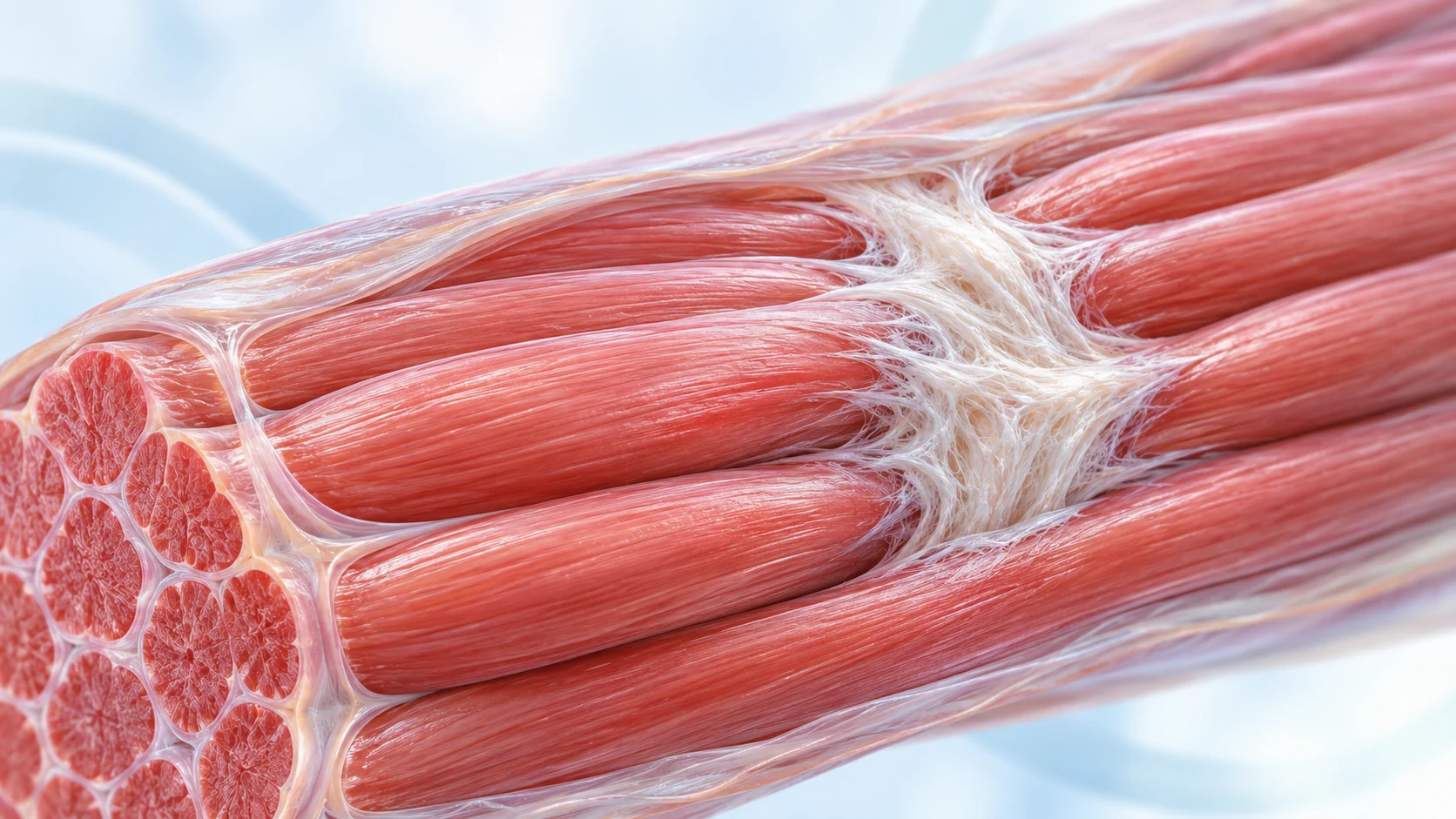
The short animation below shows the idea this article builds on. Healthy muscle fibers glide past each other. An adhesion binds them together, so the muscle can't fully stretch or contract.
Not all connective tissue is mechanically the same
The study, published in the Journal of the American Osteopathic Association, built a three-dimensional mathematical model of how fascia deforms under the compression and shear of hands-on treatment. It looked at three tissues:
- Fascia lata: the dense sheet on the outside of the thigh that includes the IT band
- Plantar fascia: the thick band on the bottom of the foot
- Superficial nasal fascia: a much softer, more compliant tissue
Fascia lata and plantar fascia are dense, highly organized tissues built to tolerate enormous loads. The nasal fascia is far more pliable, which let the researchers compare stiff and soft connective tissue side by side. The results depended almost entirely on the tissue.
Dense fascia takes enormous force to deform
For the fascia lata, the model calculated that about 9,075 newtons of pressing (normal) force and 4,515 newtons of sideways (tangential) force would be needed to produce just 1% compression and 1% shear. The plantar fascia was similar: about 8,359 N and 4,158 N.
That's roughly 2,000 pounds of pressing force and about 1,000 pounds of sideways force for a 1% change. No clinician comes close.
So if someone says they are stretching or reshaping the plantar fascia or IT band with their hands, this study strongly challenges that explanation.
Softer tissue behaved very differently
The superficial nasal fascia was another story. During a 20-second manual treatment, the researchers measured the applied forces and used their model to calculate how the tissue would deform. Forces within a realistic clinical range were predicted to produce up to about 9% compression and 6% shear.
Reading the study's shear graph, roughly 25–30 newtons of sideways force (about 5.6 to 6.7 pounds) corresponds to around 5–6% shear in this softer tissue.
That isn't thousands of pounds. It's roughly six pounds, which a trained manual therapist can produce easily.
Why six pounds changes the conversation
The claim that manual therapy can't mechanically affect connective tissue treats every connective tissue as if it had the same material properties. They don't:
- A thick plantar aponeurosis isn't mechanically equivalent to loose connective tissue.
- The IT band isn't mechanically equivalent to the connective tissue wrapped around individual muscle fibers.
- Dense tendon isn't mechanically equivalent to a small fibrotic interface between two layers that are supposed to slide independently.
The underlying principle is basic biomechanics: the force needed to deform connective tissue depends enormously on the tissue being treated.
What this has to do with a muscle adhesion
When we say adhesion at Novo Soft Tissue, we don't mean an entire sheet of dense fascia has turned into scar tissue that needs to be crushed.
We mean a localized area of abnormal soft-tissue restriction. Tissues that should lengthen, shorten, or slide relative to one another no longer move normally. Depending on the tissue and its history, that restriction may involve altered extracellular matrix, collagen buildup, fibrosis, connective-tissue thickening, or abnormal sticking between tissue layers. (More on that in Fibrous Adhesion and Musculoskeletal Pain.)
Mechanically, that is a very different target from the whole plantar fascia. Dense fascia may resist manual deformation almost completely. Softer connective tissue can deform substantially under ordinary hand pressure. That gives a plausible mechanical basis for why precisely directed force may influence a localized adhesion.
Shear may matter most
The paper separates two kinds of load:
- Compression pushes tissue inward.
- Shear moves one tissue surface relative to another.
Shear lines up with how muscle works. Muscle fibers, fascicles, the connective layers around them (epimysium and perimysium), the surrounding fascia, and neighboring structures all have to move relative to each other. Healthy movement depends on that sliding. An adhesion can interfere with it.
So skilled manual adhesion release doesn't mean pushing harder and harder. It means finding a restricted tissue interface and applying force in a direction that creates relative movement across it. That is a shear problem, and the Chaudhry model shows that softer connective tissue can undergo substantial shear from modest forces.
Precision over brute force
If force alone were the treatment, anyone who could press hard could treat an adhesion. The more important questions are:
- Where is the restriction?
- Which structure is involved?
- Which direction does that tissue normally move, and in which direction has motion been lost?
- Where should force go to create useful shear, instead of compressing everything under the hand?
Answering them takes skilled palpation and diagnosis. A broad massage stroke can deliver a lot of force without concentrating it where the tissue is stuck. A smaller, accurately directed force can have a very different mechanical effect. More force isn't necessarily better. More precise force can be.
What about lasting change?
The researchers also calculated the stresses associated with plastic deformation, where tissue doesn't fully return to its original shape after the force is removed. For the superficial nasal fascia, those predicted stresses were very low, about 3.46 to 4.92 N/cm², which the authors attributed to how soft the tissue is.
That doesn't mean six pounds of pressure permanently removes every adhesion. Force and stress aren't the same measurement, and this paper didn't measure the mechanical properties of adhesions inside muscle. It does reinforce the central point: compliant connective tissue behaves very differently from dense fascia under load.
Does this prove manual therapy removes adhesions?
Not by itself.
The researchers studied fascia lata, plantar fascia, and superficial nasal fascia. They didn't identify an adhesion inside a muscle, treat it, and then examine the tissue afterward to show it was gone. This paper shouldn't be presented as direct proof that manual therapy eliminates every kind of muscular adhesion.
What it does establish is that manual forces are mechanically capable of producing substantial deformation in softer connective tissues. The authors concluded that the "release" clinicians feel is unlikely to come from deforming firm tissues like the plantar fascia or fascia lata, but could come from deformation of softer tissue. That is a long way from saying hands can't change tissue at all.
A better way to think about adhesion release
The outdated version of manual therapy: push hard enough to break up the scar tissue.
The biomechanics point to something more precise. Find the restricted tissue interface. Apply enough well-directed force to create deformation and shear in tissue that can be influenced. The aim is to find the tissue that isn't moving and treat it, without trying to overpower the strongest connective tissue in the body.
The bottom line
The Chaudhry study corrects both extremes of the manual-therapy debate. Hands can't easily stretch the plantar fascia or IT band. They can mechanically change softer connective tissue.
An adhesion doesn't have to behave like an IT band for manual treatment to affect it. If the restricted tissue is compliant enough, and the clinician can find it and direct force into the right tissue plane, modest force may be enough to create meaningful change.
So the useful questions go beyond "Can hands change fascia?" What tissue are we treating? How stiff is it? Where is movement restricted? And can we apply force precisely enough to restore that movement?
Sources
- Chaudhry H, Schleip R, Ji Z, Bukiet B, Maney M, Findley T. Three-dimensional mathematical model for deformation of human fasciae in manual therapy. J Am Osteopath Assoc. 2008;108(8):379–390. PMID: 18723456. (link)


