The treatment
What Is EMTT?
Extracorporeal magnetotransduction therapy (EMTT) delivers a high-intensity, rapidly oscillating magnetic field through a loop applicator into a volume of tissue. The changing field induces a secondary electrical field inside the tissue.
EMTT is not shockwave. ESWT is a mechanical pressure pulse. EMTT is electromagnetic, with no mechanical pulse.
How EMTT Differs From ESWT
The two differ in energy type, sensation, reach, and proposed mechanism.
| ESWT (Focused/Radial) | EMTT | |
|---|---|---|
| Energy | Acoustic pressure wave | Oscillating magnetic field |
| Sensation | Mechanical impact, often felt | Usually painless, no mechanical pulse |
| Reach | Set by focal depth or decays from the applicator | Penetrates broadly through a treatment volume |
| Proposed effect | Mechanotransduction — fibroblast/ECM remodeling, cavitation-driven neovascularization | Electrotransduction — VEGF-driven angiogenesis, anti-inflammatory signaling, cellular metabolism |
Because they work through different mechanisms, they are often paired. ESWT treats a discrete mechanical target, such as a tendon insertion or a fibrotic band. EMTT treats a broader degenerative or inflamed joint volume, where a focused mechanical pulse may not suit.
Mechanism
How It Works
The physics are the same as pulsed electromagnetic field (PEMF) therapy, at far higher intensity. EMTT devices typically run around 80 millitesla, roughly 10–80 times the field strength of a standard PEMF unit. The induced field is thought to raise VEGF (vascular endothelial growth factor), which promotes local blood flow, and to modulate inflammatory signaling.
These proposed effects come mainly from laboratory and early clinical research. They describe how EMTT might act on tissue; they are not direct proof of benefit for an individual patient.
For related cellular research on shockwave therapy in knee OA, see Cellular Senescence, Adhesion, and Shockwave.
Indications
When We May Use It
We use EMTT where the evidence points: degenerative and inflamed joint tissue and enthesis pain. The Hollander trial directly studied knee osteoarthritis, rotator cuff enthesopathy, and lumbar spondyloarthrosis (facet-joint driven low back pain).
EMTT does not replace treatment of a mechanically adhered tendon or fascia. Focused or radial ESWT and manual release are used for that.
We pair EMTT with focused ESWT when the problem sits in a joint or a deep muscle compartment, not at a single, accessible tendon insertion. It is not a default add-on to every visit.
For how EMTT fits into an exam-first knee plan, see knee osteoarthritis treatment. For the shoulder, see rotator cuff and shoulder pain treatment. For the low back, see chronic low back pain treatment.
EMTT Alone or With Shockwave? → · See how EMTT fits with our other treatments →
Precautions
When We May Not Use It
We screen for these at your exam. Any of them can rule EMTT out or change the plan:
- A pacemaker, defibrillator, or other implanted electronic device
- Metal implants in the treatment area
- Pregnancy
- Cancer in the treatment area
Another approach comes first when:
- a tendon rupture or significant tear is suspected
- a fracture or stress fracture is possible
- numbness, tingling or weakness is progressing
- the pain pattern points to a joint, spinal or medical problem that needs imaging or referral
Evidence
What the Evidence Shows
Best current evidence
The best current evidence is a 2026 double-blind, sham-controlled randomized trial by Hollander and colleagues in the Journal of Back and Musculoskeletal Rehabilitation. It included 126 patients with knee osteoarthritis (31), rotator cuff enthesopathy (43), or lumbar spondyloarthrosis (52). They received eight weekly EMTT sessions (80 mT, 8 Hz, 10,000 pulses per session) or an identical-feeling sham.
At 12 weeks, the EMTT group reported significantly less pain (VAS 2.2 vs. 4.2, p<0.001) and better physical function (SF-12 PCS 45.5 vs. 38.7, p<0.001) than sham. Mental-health scores did not differ between groups.
Alongside shockwave
In rotator cuff problems, an 86-patient trial found that adding EMTT to shockwave reduced pain more at 24 weeks than shockwave with sham EMTT (Klüter, 2018).
What is not yet known
The trial has real limits. Follow-up stopped at 12 weeks. There were no imaging or biomarker endpoints. It was a single-center trial with a mixed patient population.
Blinding was imperfect. In the active group, 59% correctly guessed their treatment, and 46% did in the sham group. Mild discomfort and skin redness were more common with active treatment. Any pain-outcome trial like this includes a real placebo response.
The authors note there is not yet a body of systematic reviews on EMTT, as there is for ESWT. This is one well-designed, sham-controlled trial: good evidence, not exhaustive evidence.
Sources: Hollander et al., Journal of Back and Musculoskeletal Rehabilitation, 2026 — PubMed · Full text on Sage · Klüter et al., Electromagn Biol Med 2018
What to expect
What Treatment Feels Like
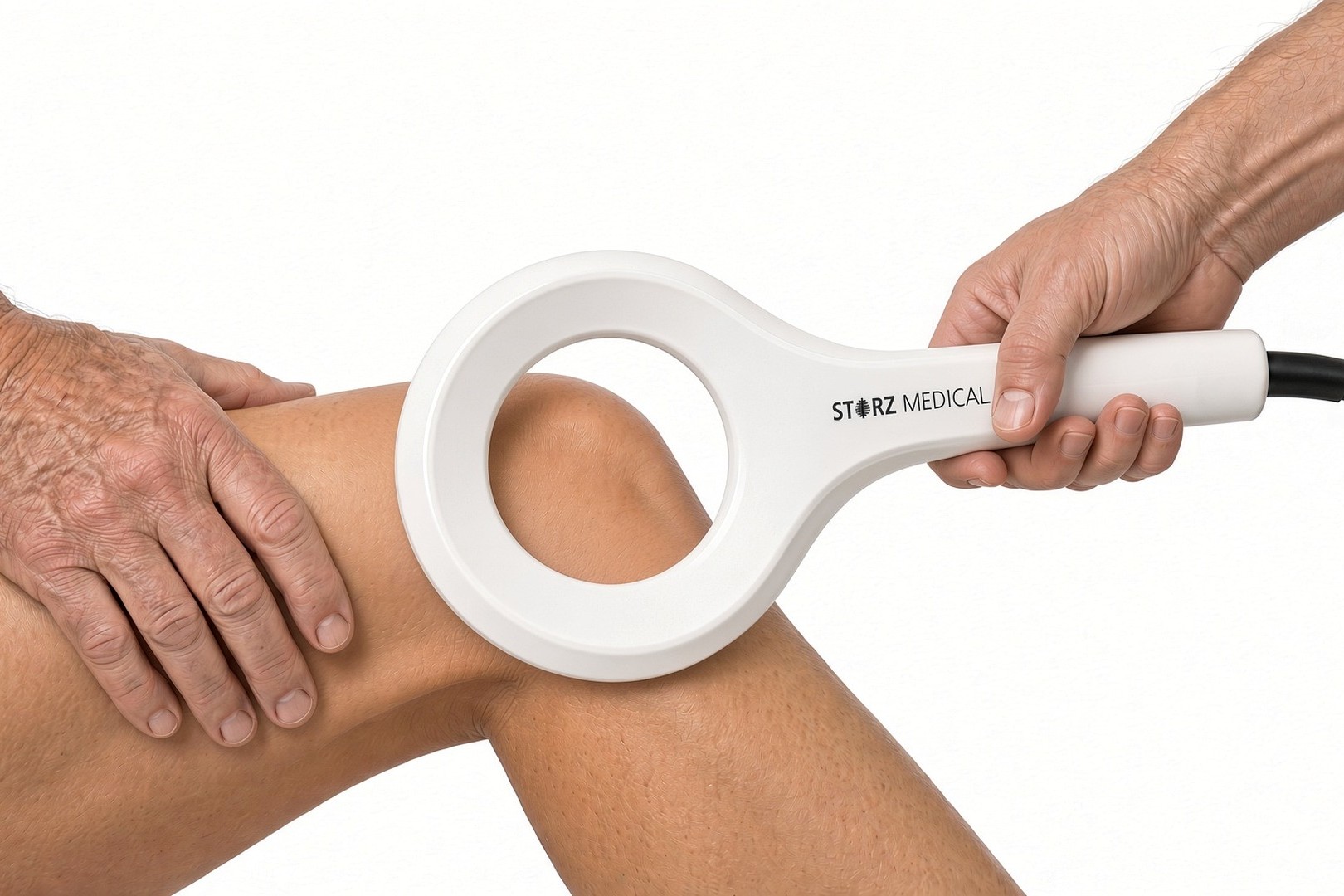
- A session takes about 15–20 minutes and is billed as a standard follow-up visit.
- The loop applicator rests over the treatment area. Most patients do not feel EMTT the way they feel shockwave.
- Novo uses the Storz Magnetolith Ultra+.
- We re-measure range of motion and strength at most visits to track change.
Usually 6–8 sessions, one week apart. The exact number depends on your diagnosis. EMTT is often paired with focused shockwave or manual adhesion release.
Treatment selection
How Novo Decides Whether to Use It
EMTT is not selected in advance, and it is not a default add-on to every visit. We first determine which tissue appears to be contributing to the problem and whether it is a joint, a tendon attachment or a muscle layer. Each tool has a different role:
- Focused shockwave: a small or deep target, such as a tendon insertion or calcific deposit.
- Radial shockwave: a broader, more superficial area of muscle, fascia or tendon.
- EMTT: a joint or a deeper, broader tissue volume where a mechanical pulse may not suit.
- Manual treatment: restricted muscle or fascia found by hand.
- Load modification and exercise: part of most tendon and muscle care, with or without a device.
- Imaging or referral: when the exam points to a tear, fracture, nerve compromise or a medical cause.
Some problems need one of these, some need a combination, and some need none of them. You do not need to choose a treatment before your visit.