The treatment
Focused and Radial ESWT, Selected by Diagnosis
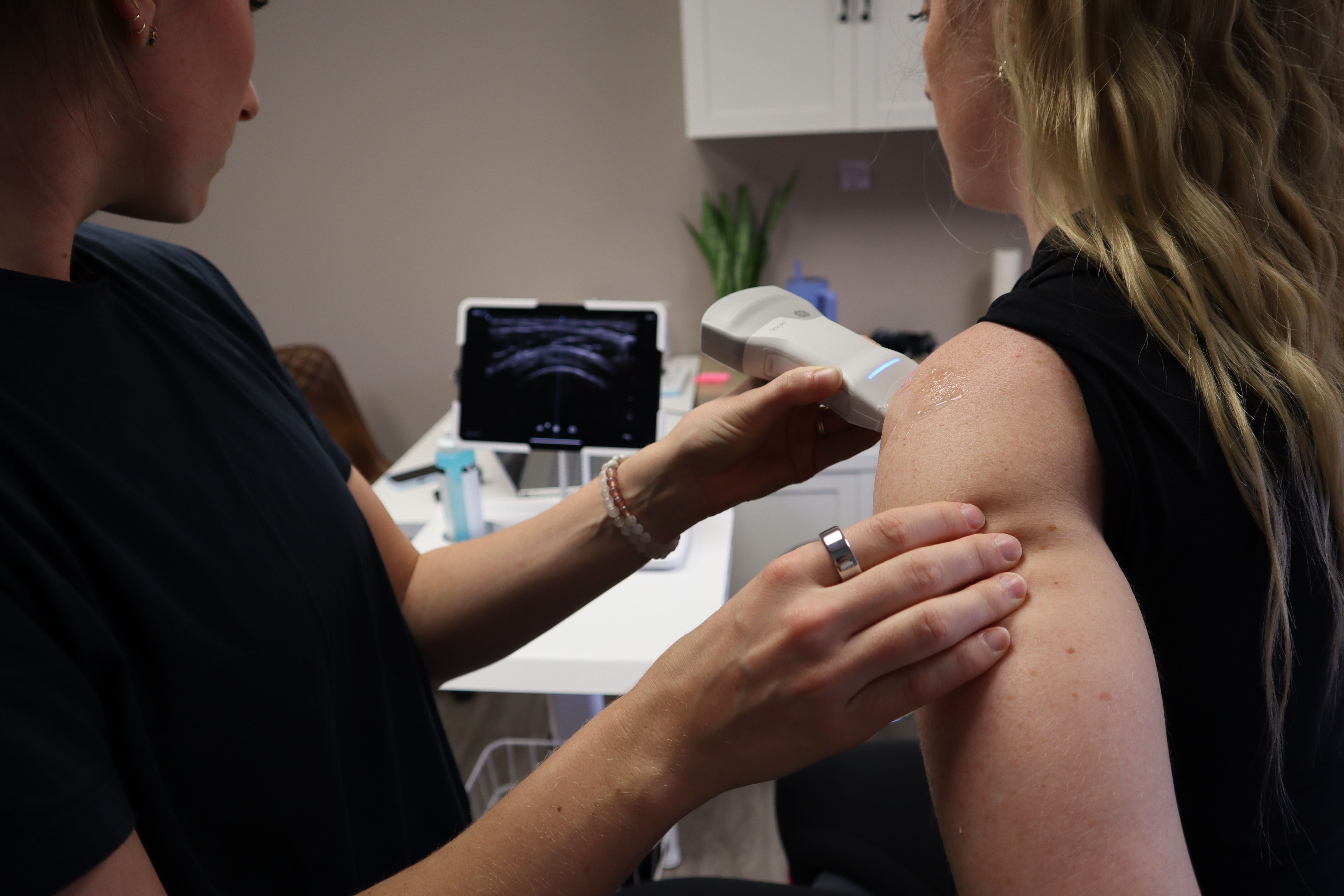
Extracorporeal shockwave therapy (ESWT) delivers short acoustic pressure pulses into tissue from a handpiece placed on the skin. Novo Soft Tissue provides two forms of it, focused shockwave therapy and radial shockwave therapy, at our Denver Tech Center office in Centennial, Colorado. Shockwave has research support for selected tendon and fascia problems and more limited support for some muscle and joint problems. It is not a treatment for every kind of pain.
We examine first. The findings decide whether you need focused ESWT, radial ESWT, both, or another tool such as manual adhesion release or EMTT.
Focused or radial shockwave?
Focused shockwaves peak at a chosen depth. They suit a discrete tendon insertion, calcific deposit, or deep fibrotic band. Radial pressure waves start at the applicator and weaken as they travel. They treat a broader, shallower field: fascia, muscle bellies, and tendon surfaces.
Each has its own page covering sessions, research, and who should not have it: focused shockwave therapy and radial shockwave therapy. For the head-to-head evidence, see Radial vs. Focused Shockwave: What the Research Shows.
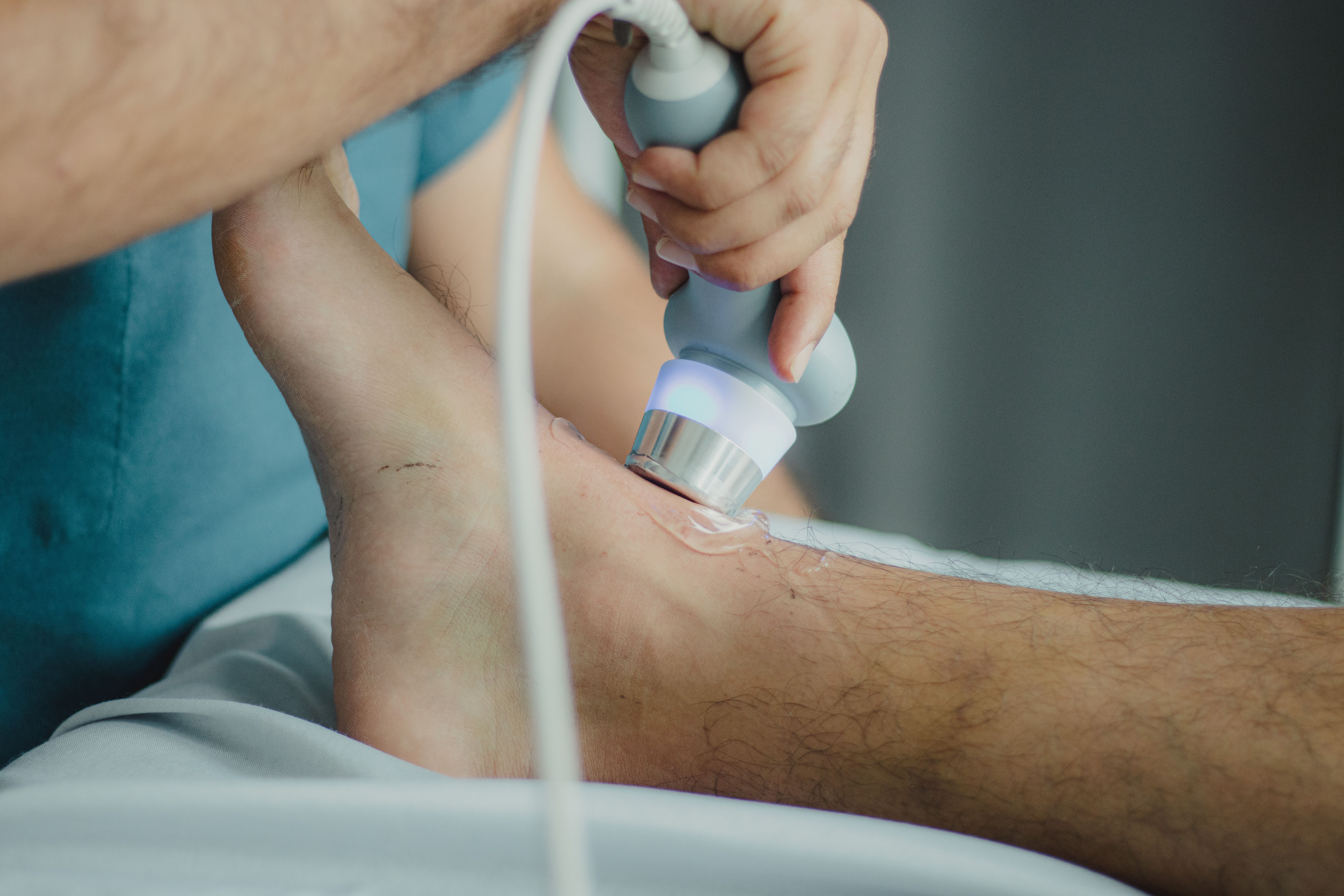
Our Storz Medical equipment: the Duolith SD1 T-Top Ultra (focused shockwave), Orthopulse Ultra 100 (radial shockwave), and Magnetolith Ultra+ (EMTT). Novo Soft Tissue is a listed Storz Medical America provider.
Mechanism
How Shockwave Works
Shockwave is a mechanical stimulus. Cells in tendon, muscle and fascia respond to mechanical load through mechanotransduction, the process by which cells convert mechanical force into biochemical signals. Proposed mechanisms include that cellular response, changes in local blood-vessel and inflammatory signaling, and effects on pain sensitivity at the treated site.
A 2026 review describes proposed antifibrotic effects of extracorporeal shockwave through TGF-β1, MAPK, VEGF and inflammatory signaling pathways (Huang et al., Chinese Journal of Tissue Engineering Research, 2026).
Much of this comes from laboratory and animal research. It explains why shockwave might help; clinical decisions rest on human trials.
Indications
Who This Is For
Most patients have had pain for three months or more and tried several other providers. Shockwave is one treatment tool we use when the examination identifies a musculoskeletal presentation where ESWT may fit. Depending on the diagnosis, that may include selected tendon, muscle, fascia, joint, or fibrotic-tissue problems. Adhesion is one possible reason pain lasts after an injury heals.
Common examples include chronic low back pain, chronic neck pain, chronic tendinopathy, Achilles tendinopathy, patellar tendinopathy, proximal hamstring tendinopathy, plantar fasciitis, selected persistent posterior tibial tendon pain, selected persistent peroneal tendinopathy, selected persistent tibialis anterior tendinopathy, selected chronic muscle injuries of the calf, including post-injury fibrotic remodeling, selected adductor-related groin pain and other chronic athletic groin pain presentations, selected persistent iliopsoas tendinopathy (evidence), selected chronic muscle injuries of the quadriceps (evidence), selected chronic distal biceps tendinopathy (evidence), selected chronic muscle-tendon injuries of the pectoralis major (evidence), selected persistent distal-triceps tendinopathy (evidence; condition-specific comparative evidence remains limited), selected superficial muscular or myofascial chest-wall conditions on safe targets after medical screening (evidence), selected superficial abdominal-wall muscle or myofascial conditions after hernia and visceral causes have been excluded (evidence), selected painful temporomandibular disorders, particularly myogenous and masticatory-muscle presentations (evidence), selected painful interdigital neuroma or Morton’s neuroma presentations, for symptom relief rather than neuroma removal (evidence), selected De Quervain tenosynovitis (evidence), selected symptomatic thumb CMC osteoarthritis, where focused ESWT has direct comparative clinical evidence although the evidence base remains small (evidence), selected stenosing flexor tenosynovitis / trigger finger, where trigger finger has direct randomized and sham-controlled ESWT evidence, including trials against corticosteroid injection and sham treatment (evidence), selected mild-to-moderate carpal tunnel syndrome, where carpal tunnel syndrome has direct randomized and meta-analytic ESWT evidence for symptom, function and selected electrophysiologic outcomes (evidence), tennis and golfer’s elbow, frozen shoulder, lateral hip pain from gluteal tendinopathy, and selected deep-gluteal and piriformis presentations of sciatic nerve pain. See all conditions we treat.
Adhesion is one possible finding, not the explanation for every case. Read about how adhesion can contribute to pain.
Precautions
When We May Not Use It
We screen for these at your exam. Any of them can rule shockwave out or change the plan:
- Pregnancy
- Blood thinners or a bleeding disorder
- Cancer in the treatment area
- A recent steroid (cortisone) injection into the area
- Infection or broken skin in the treatment area
- Open growth plates in the treatment area
- A target that would direct energy toward the lungs or abdominal organs
Another approach comes first when:
- a tendon rupture or significant tear is suspected
- a fracture or stress fracture is possible
- numbness, tingling or weakness is progressing
- the pain pattern points to a joint, spinal or medical problem that needs imaging or referral
Evidence
What the Evidence Shows
In degenerative rotator cuff tendinopathy with partial supraspinatus tears, a 2026 randomized trial of 60 adults found radial ESWT plus home exercise improved ASES shoulder scores more than physical-therapy modalities (interferential current, shortwave diathermy, and magnetothermal therapy) plus the same home exercise (Wang et al., Journal of Clinical Medicine, 2026;15:471). It did not compare radial ESWT with a progressive exercise program.
In lateral epicondylitis (tennis elbow), a 2026 randomized trial found radial ESWT plus exercise reduced pain more than exercise alone at 6 and 12 weeks (Journal of Orthopaedic Science, 2026). See the full tennis elbow evidence review.
Shockwave is chosen by diagnosis, not by body region. Chronic ankle pain after a sprain is a good example: some tendon and soft-tissue problems around the ankle may fit, but chronic ankle instability and loose lateral ligaments are not established shockwave indications (chronic ankle pain evidence review).
Plantar fasciitis and calcific rotator cuff tendinopathy are among the more consistently supported uses, while evidence for many other conditions is mixed or limited. Each condition page summarizes its own trials, and the focused and radial pages set out the evidence by device type.
Shockwave is one of four tools we use. Compare all four treatment tools, or read EMTT Alone or With Shockwave?
Safety
Can Shockwave Damage a Tendon?
Serious tendon injury is not a commonly reported outcome in the shockwave studies we review. The side effects most often reported are temporary, mainly local pain and skin redness. A 2024 systematic review of 56 studies in athletes and physically active people reported minimal side effects (Rhim et al., British Journal of Sports Medicine, 2024, PMID 38228375), and in a 2024 meta-analysis of plantar fasciitis trials, local pain and mild redness were the most common side effects (plantar fasciitis evidence review).
Low reported risk is not the same as no risk. We do not use shockwave over a suspected tendon rupture or significant tear, or within 5 weeks of a steroid injection into the area. These are checked at the exam. Results also differ between people for reasons beyond technique; see why shockwave results vary.
What to expect
What Treatment Feels Like
- Focused shockwave sessions take about 15–20 minutes. Radial shockwave is usually part of a 10–15 minute follow-up visit.
- We adjust the intensity to you. It can sting over a tender spot.
- Mild soreness for a day or two afterward is common.
- Avoid ibuprofen and other anti-inflammatories for a few days afterward. If one was prescribed, ask the prescribing doctor first.
- A typical plan is 4–6 sessions, one week apart, depending on the diagnosis.
Treatment selection
How Novo Decides Whether to Use It
Shockwave is not selected in advance. We first determine which tissue appears to be contributing to the problem, then whether focused, radial, both or neither fits. Each tool has a different role:
- Focused shockwave: a small or deep target, such as a tendon insertion or calcific deposit.
- Radial shockwave: a broader, more superficial area of muscle, fascia or tendon.
- EMTT: a joint or a deeper, broader tissue volume where a mechanical pulse may not suit.
- Manual treatment: restricted muscle or fascia found by hand.
- Load modification and exercise: part of most tendon and muscle care, with or without a device.
- Imaging or referral: when the exam points to a tear, fracture, nerve compromise or a medical cause.
Some problems need one of these, some need a combination, and some need none of them. You do not need to choose a treatment before your visit.
Location
Location and Hours
Novo Soft Tissue is at 6059 S. Quebec St., Suite 203, Centennial, CO 80111, in the Denver Tech Center area near Greenwood Village, just west of I-25 and Orchard Road. Office hours are Tuesday and Thursday, 12:00 PM to 5:00 PM, and Wednesday and Friday, 6:30 AM to 11:00 AM.
Patients come from Denver and across South Denver, including Lone Tree, Englewood, and Parker. See distances and directions.
Novo is direct pay. We accept cash, major credit cards, HSA, and FSA, and provide documentation for possible reimbursement.