The treatment
What Focused Shockwave Therapy Is
Focused shockwave therapy (focused ESWT), one of the two forms of extracorporeal shockwave therapy, concentrates acoustic energy at a chosen depth. It is used for small, deeper targets such as tendon insertions, calcific deposits, and selected areas of fibrous adhesion. We use it only when a comprehensive exam shows it suits the tissue.
How focused shockwave differs from radial
Focused shockwaves peak at a set depth. Radial pressure waves start strongest at the applicator and weaken as they travel, so they treat a broader, shallower area. Novo uses a Storz Duolith SD1 T-Top Ultra for focused shockwave and a Storz Orthopulse Ultra 100 for radial. See Radial vs. Focused Shockwave: What the Research Shows.
Mechanism
How It Works
A shockwave is a short, high-pressure acoustic pulse. Cells in tendon, muscle and fascia respond to mechanical load, and proposed mechanisms include mechanotransduction (cells converting mechanical stress into biochemical signals), changes in local blood-vessel and inflammatory signaling, and effects on pain sensitivity at the treated site. In calcific tendinopathy, breakdown and resorption of the deposit has also been described.
Mechanical stress from focused pulses can change fibroblast behavior and the extracellular matrix. A 2026 review (Huang et al., Chinese Journal of Tissue Engineering Research) found extracorporeal shockwave reduces fibrosis by modulating TGF-β1, MAPK, VEGF, and inflammatory pathways, with less excess collagen and better tissue organization.
Much of this mechanistic work comes from laboratory and animal studies. It helps explain why shockwave might work; it does not show that it will work for a particular person. Treatment decisions rest on the human trials summarized below.
Indications
When We May Use It
Focused shockwave may be considered when the examination identifies a small or deep target that appears to be contributing to symptoms:
- a painful tendon insertion or deep tendon region
- a calcific deposit within a tendon
- a deep, localized band of fibrous muscle adhesion
- selected joint-adjacent targets, sometimes alongside EMTT
A condition appearing below does not mean focused shockwave is the right choice for it. The evidence differs by condition, and for several tendons radial shockwave has been studied as much or more.
Condition-specific notes
- A painful tendon insertion, as in tennis and golfer's elbow or chronic tendinopathy
- The plantar fascia at the heel in plantar fasciitis
- Selected posterior tibial tendon presentations. ESWT protocol selection depends on diagnosis and target; current direct posterior tibial evidence is limited (evidence review)
- Selected peroneal tendon presentations. Focused ESWT has appeared in emerging peroneal-tendon case literature, but high-quality peroneal-specific comparative evidence is lacking (evidence review)
- Selected persistent tibialis anterior tendinopathy. Direct tibialis-anterior-specific comparative evidence remains limited (evidence review)
- Selected chronic calf muscle injury. Focused shockwave appears in muscle and myofascial research, but it has not been shown to be more effective than radial shockwave for post-injury fibrotic tissue (evidence review)
- Selected chronic athletic groin pain. A 2026 prospective pilot study combined three focused ESWT sessions with structured rehabilitation in 31 soccer players with groin pain syndrome and reported large improvements in HAGOS and pain over four months. Because the study had no rehabilitation-only control group, the specific contribution of focused ESWT remains uncertain (evidence review)
- Selected persistent iliopsoas tendon pain. Focused ESWT may be considered for selected persistent iliopsoas tendon pain, although direct condition-specific comparative evidence remains limited (evidence review)
- Selected persistent skeletal-muscle injuries, including some chronic quadriceps presentations. Direct rectus-femoris-specific comparative evidence is limited, and focused shockwave has not been shown to outperform radial shockwave for muscle (evidence review)
- Selected distal biceps tendinopathy presentations. Direct condition-specific published evidence is currently stronger for radial ESWT, which is the modality that has been studied in this tendon; that reflects evidence availability, not proven modality superiority (evidence review)
- Selected chronic muscle-tendon injuries of the pectoralis major, after a significant tear has been excluded. Direct pectoralis-specific evidence is lacking for either focused or radial shockwave (evidence review)
- Selected persistent distal-triceps tendinopathy. Condition-specific comparative evidence remains limited, and no shockwave modality has been shown to be superior for this tendon (evidence review)
- Focused shockwave is not directed through the chest wall toward the lungs or heart. Selected superficial muscular or myofascial chest-wall conditions are approached cautiously, after medical causes, fracture and slipping rib have been excluded (rib and intercostal pain, evidence review)
- Focused shockwave is not directed through the abdominal wall toward the abdominal organs, and it is not used for a hernia or nerve entrapment. Selected superficial abdominal-wall muscle or myofascial conditions are approached cautiously after medical screening (abdominal wall pain; evidence review).
- Selected myogenous temporomandibular disorders. A randomized placebo-controlled trial of 64 patients applied focused shockwave to the masseter and found significantly lower pain than placebo through six weeks; it is directed at the muscle, not through the joint, ear or eye, and is not used to reposition a disc (evidence review).
- Selected symptomatic thumb CMC osteoarthritis. Two small randomized trials applied focused ESWT to the thumb CMC joint under ultrasound guidance, one against hyaluronic acid injections and one against exercise, and both groups improved in each; neither had a sham control, and the evidence measures symptoms and function, not cartilage (evidence review)
- Selected trigger finger. A double-blind sham-controlled trial of 60 patients used a protocol its authors describe as wide-focused ESWT and found lower pain and QuickDASH disability than sham at six months in the higher-energy group. Wide-focused is the source’s own term and is not interchangeable with every focused protocol, and shockwave does not cut or release the A1 pulley (evidence review)
- Selected mild-to-moderate carpal tunnel syndrome. A placebo-controlled pilot trial of 30 patients found improvements in pain, grip strength, symptom severity and distal motor latency after three sessions of focused ESWT, and a 2023 meta-analysis found benefit with both focused and radial devices. Neither has been shown to be superior, and shockwave does not decompress the nerve (evidence review)
- Selected Achilles presentations, although the strongest classic Achilles randomized trials used low-energy radial treatment and current evidence does not establish focused ESWT as universally superior
- Selected patellar tendinopathy presentations. Both focused and radial ESWT have been studied in patellar tendinopathy, and current evidence does not establish either as universally superior (evidence review)
- The gluteus medius and minimus insertion in lateral hip pain and gluteal tendinopathy, where several randomized trials have studied focused ESWT (evidence review)
- The deep hamstring attachment at the sitting bone in selected proximal hamstring tendinopathy presentations. Radial and focused ESWT have both been used, and current evidence does not establish either as superior (evidence review)
- Calcific deposits in a tendon, including calcific rotator cuff tendinopathy, one of the stronger evidence areas for shoulder shockwave
- Deep bands of fibrous muscle adhesion
- Selected deep-gluteal sciatic nerve presentations. Focused ESWT may be selected for deeper targets, but current piriformis-syndrome evidence does not establish universal superiority over radial treatment (evidence review)
- A smaller or deeper target in chronic low back pain, when the exam identifies one
- Localized upper-trapezius trigger points in myofascial neck pain, where a 2025 randomized trial found focused shockwave reduced measured tissue stiffness
- Knee pain from osteoarthritis, often paired with EMTT (Storz Magnetolith Ultra+) when the problem sits in a joint or a deep muscle compartment
Precautions
When We May Not Use It
We screen for these at your exam. Any of them can rule focused shockwave out or change the plan:
- Pregnancy
- Blood thinners or a bleeding disorder
- Cancer in the treatment area
- A recent steroid (cortisone) injection into the area
- Infection or broken skin in the treatment area
- Open growth plates in the treatment area
- A target that would direct energy toward the lungs, the abdominal organs, the brain or the spinal cord
Another approach comes first when:
- a tendon rupture or significant tear is suspected
- a fracture or stress fracture is possible
- numbness, tingling or weakness is progressing
- the pain pattern points to a joint, spinal or medical problem that needs imaging or referral
Evidence
What the Evidence Shows
Evidence for focused shockwave varies widely by condition. Where focused and radial devices have both been studied, research generally has not shown one to be clearly better.
Most consistent support
Chronic plantar fasciitis: a large multicenter placebo-controlled trial of focused ESWT reported clinically meaningful benefit (Gollwitzer, 2015).
Calcific rotator cuff tendinopathy: a 2024 meta-analysis of 21 randomized trials found shockwave better than sham for pain and function at 24 weeks, with high-energy treatment better than low-energy, although the certainty of the evidence was rated very low (Brindisino, 2024).
Moderate or mixed evidence
Gluteal tendinopathy: in a 103-patient randomized trial, focused ESWT plus exercise reduced pain more than sham plus exercise at two months (Ramon, 2020), but reviews report modest or inconsistent overall benefit (Rhim, 2024; Harding, 2024).
Tennis elbow, patellar and Achilles tendinopathy also have trial evidence with varying results. Several of the classic Achilles trials used low-energy radial treatment (Rompe, 2008).
Emerging or limited evidence
Myogenous jaw pain, thumb CMC osteoarthritis, trigger finger, carpal tunnel syndrome, chronic muscle injury and groin pain have small trials, pilot studies or largely experimental evidence. Focused shockwave may be considered in selected cases, but the evidence does not support routine use.
A small 2026 randomized trial studied fibrosis after breast reconstruction in 36 women. Higher-energy ESWT improved tissue softness, lesion size, and ultrasound homogeneity compared with a lower dose. It was presented at the Plastic Surgery Research Council meeting and is not yet published in a journal.
Condition-by-condition reviews are linked in the notes above. For the two device types side by side, see Radial vs. Focused Shockwave: What the Research Shows.
Sources: Gollwitzer et al., J Bone Joint Surg Am 2015 · Brindisino et al., Physiother Res Int 2024 · Ramon et al., J Bone Joint Surg Am 2020 · Rhim et al., JBJS Rev 2024 · Harding et al., Musculoskeletal Care 2024 · Rompe et al., J Bone Joint Surg Am 2008 · Chinese Journal of Tissue Engineering Research, 2026 · Nguyen et al., Plastic Surgery Research Council meeting abstract, 2026
What to expect
What Treatment Feels Like
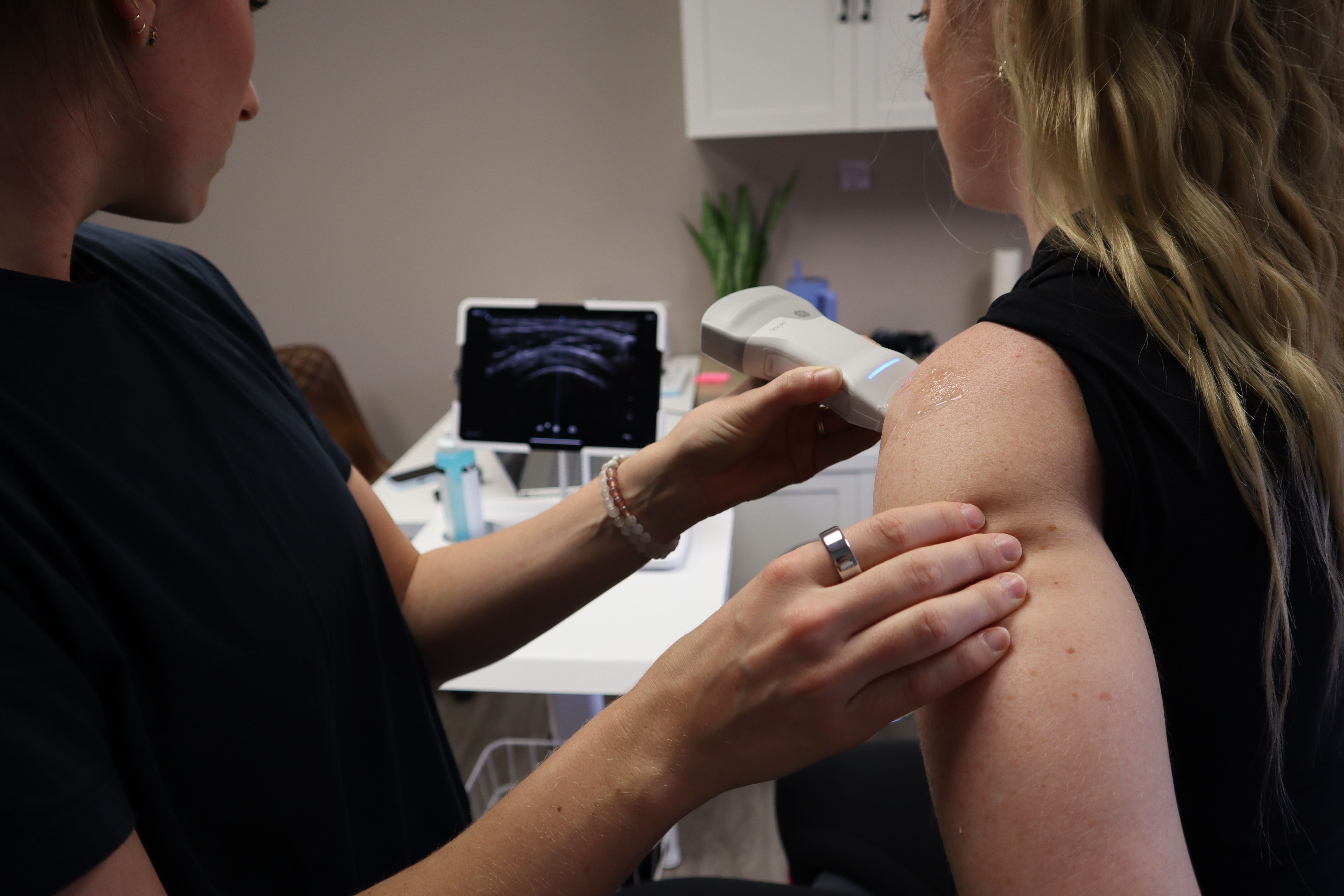
- A session takes about 15–20 minutes.
- We aim the applicator at the spot found in your exam and adjust the intensity to you. It can sting over the sore spot.
- Mild soreness for a day or two afterward is common.
- Avoid ibuprofen and other anti-inflammatories for a few days afterward. If one was prescribed, ask the prescribing doctor first.
- We re-measure range of motion and strength at most visits to track change.
Usually 4–6 sessions, one week apart. The exact number depends on your diagnosis. It is often combined with manual adhesion release on any layer that is still restricted.
Treatment selection
How Novo Decides Whether to Use It
Focused shockwave is not selected in advance. We first determine which tissue or structure appears to be contributing to the problem, and how deep and how localized it is. Each tool has a different role:
- Focused shockwave: a small or deep target, such as a tendon insertion or calcific deposit.
- Radial shockwave: a broader, more superficial area of muscle, fascia or tendon.
- EMTT: a joint or a deeper, broader tissue volume where a mechanical pulse may not suit.
- Manual treatment: restricted muscle or fascia found by hand.
- Load modification and exercise: part of most tendon and muscle care, with or without a device.
- Imaging or referral: when the exam points to a tear, fracture, nerve compromise or a medical cause.
Some problems need one of these, some need a combination, and some need none of them. You do not need to choose a treatment before your visit.